

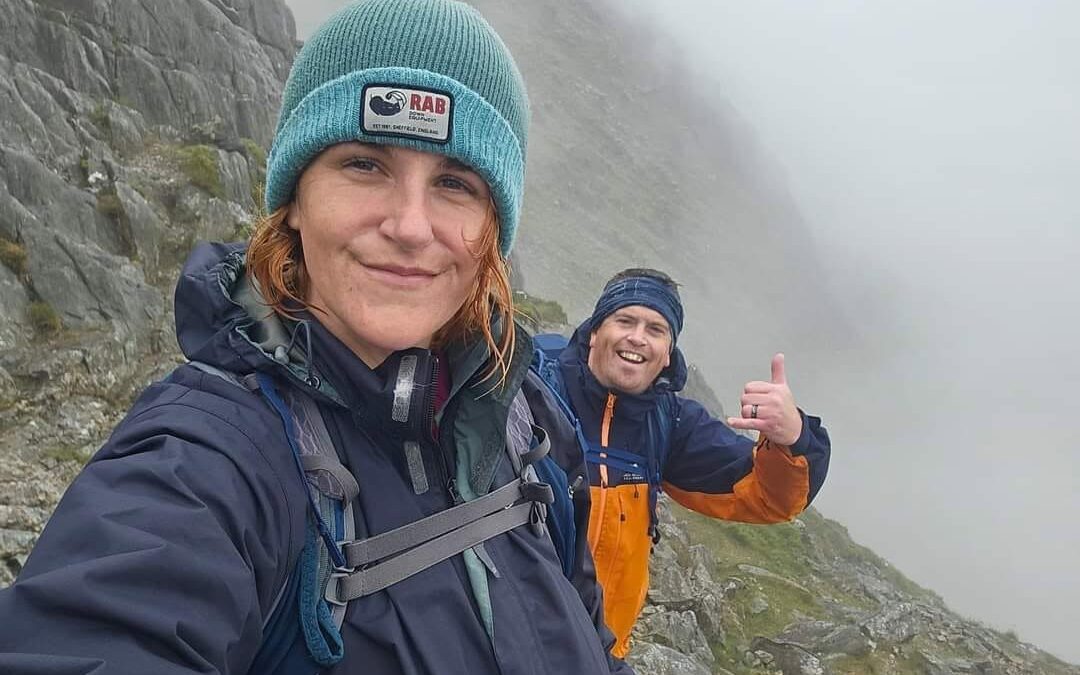
Rob Havelock and Lianne Jones are a couple who are over three years in recovery from addiction. In this conversation with Wulf Livingston, who has known them both from their early days visiting Penrhyn House, the residential part of North Wales Recovery Communities (NWRC), both initially talk about their days being addicted to drugs and alcohol. They then describe their early recovery journeys, which included a relapse and return to Penryhn House, and describe factors that facilitated their ongoing recovery within NWRC.
Rob describes his developing love of the mountains, becoming a mountain guide, and setting up Sober Snowdonia, a walking and outdoor recovery community. Lianne describes her love of the outdoors and becoming an ultra-marathon participant. Both talk about the impact of their outdoors activities on their recovery. Wulf informs Lianne and Rob that what he loves about both of them is what they offer to the rest of us, their amazing passion and enthusiasm. Their Story is really something very special.
I would like to take this opportunity of thanking Rob for taking my partner Linda and I on a wonderful walk on Anglesey when we visited North Wales in September 2025.
Wulf’s conversation with Rob and Lianne is edited into 10 films totalling just over 65 minutes. Details of each film are included below.
1. Addiction and Trauma [6’17”]
Wulf Livingston asks Rob Havelock and Lianne Jones, a couple living in North Wales, if they could give us an initial ‘flavour’ of their recovery journey from addiction. Rob was born in Porthmadog, North Wales, 40 years ago. His life took him to Manchester for 16 years, where he got married, had a son, and bought a house. His cocaine addiction and alcoholism then spiralled out of control, and he lost everything. He started attending 12-Step meetings but relapsed, and eventually returned to North Wales with tail between his legs.
Rob initially spent time at his Mum’s in Porthmadog trying to sober up. When he began searching for 12-Step meetings in his area, the first one that came up was Penrhyn House. He took himself off to Bangor, where he attended meetings at Penrhyn as a local community member, rather than as a resident. However, something was missing for Rob there. He was full of ego and even though he had relapsed previously, he thought he knew better than anyone at Penrhyn House. He met Lianne at a meeting in Penrhyn House about two and a half years ago [this was from the time of the conversation, in March 2025], and they started a relationship.
Lianne is also from North Wales, from a town called Pwllheli on the Llŷn Peninsula. She experienced a good deal of abuse and trauma in her earlier life, and the impact of this gradually built up over time as different things happened to her. She eventually became addicted to painkillers, illicit drugs, and alcohol. Lianne started travelling around the country, before settling in Derbyshire for a couple of years. Her situation got a lot worse, and she became very selfish, caring for no one other than herself. She wanted to change and was therefore visiting a Substance Misuse Service, but that didn’t help. She had no one else to whom she could turn.
After she moved back to North Wales, Lianne heard from a friend about Penrhyn House. She reached out to Penrhyn and started attending as an outside community member. She connected with people for a couple of months, attended Fellowship meetings and did some recovery work, but realised that she didn’t really want that type of life. She just wanted to do what she wanted to do, and not care about other people. Both Lianne and Rob later relapsed.
2. Relapse in Blaenau Ffestiniog [4’02”]
Rob and Lianne met at Penrhyn House in mid-2022. He took a job in Blaenau Ffestiniog in September 2022, and Lianne was offered a flat there the following month. They thought at the time that things were really coming together for them. However, the lads at Rob’s work would share stories of their escapades over the weekend, and there was still part of him that wanted to engage in such activities. He was always guilty of romanticising a life which involved him sitting in a pub with his pint, being Jack the Lad, and enjoying the company of his mates. He soon relapsed into drinking. However, he found only a short-lasting enjoyment from alcohol. Wulf points out that many people forget the role of pleasure in the process of addiction.
Lianne relapsed soon after Rob. She had experienced the mindset of thinking, ‘I’m away from people in Bangor and can do what I want.’ Something changed in her then, and she realised that she really did want a new life. She was offered a place in Penrhyn House and moved in as a resident. However, she only remained a resident for about six weeks. Her life there just wasn’t working for her for various reasons. She thinks a lot was down to her past traumatic experiences. She just couldn’t deal with being with a lot of people and the conflicts that sometimes arose. She also still wanted the relationship with Rob and wasn’t always being honest with staff members at Penrhyn House.
3. A Couple in Recovery [7’40”]
Rob left Blaenau Ffestiniog and was homeless in Bangor for a short while. He was then offered emergency accommodation in Felinheli, about five miles away, and Lianne moved in with him after leaving Penrhyn House. They both attended Penrhyn House meetings, although there was an initial period of complications for him coming back to the place.
He says he can’t blame anybody at Penrhyn, even though he did at the time, but there was an initial element of mistrust by staff about his intentions towards Lianne during her time as a resident. There was a concern that he was just preying on her, and staff did their job in safeguarding one of their residents. They put in place a few hurdles in relation to Rob accessing Penrhyn House services, to ensure that he was actually there for recovery. He had to leave the house immediately after attending each meeting.
Rob was lucky enough to find a sponsor in one of his first meetings after coming back to Penrhyn House. From that point, he started doing all the things he hadn’t done during his previous time there. He put 110% into his recovery. Initially, he just wanted to prove everyone wrong in relation to his motives. He points out that this is not always the best way to do things, but it worked for him. He was doing everything his sponsor asked him to do.
At the beginning, it was frustrating for Lianne hearing what people were saying about Rob, particularly as they were part of her support network. However, she realised that she had to get past her frustration regarding their suspicions and concentrate on herself and her ongoing recovery. She also needed to focus on being part of the community. She had to let go of other people’s negative opinions, and just focus on what was important. As time progressed and Lianne and Rob’s recoveries strengthened, peoples’ perceptions of the pair as individuals changed. Moreover, it became accepted that they were a loving couple.
Rob agrees with Wulf that he and Lianne were an exception to the commonly held view that romantic relationships don’t work for people who are in early recovery. He points out that their relationship put them in a somewhat difficult situation. ‘What did we say to other people who wanted to start a romantic relationship, given that we knew that many such relationships fail in early recovery?’ The situation became tougher when they started sponsoring other people. Some people would come up to them and say, ‘How do you feel about me getting involved in a personal relationship?’ They had to be honest and say, ‘Don’t look at us as a benchmark.’
Lianne points out that a lot of people said to her, ‘But you work,’ referring to her and Rob. Her response, particularly to females, was to tell them to avoid getting into a relationship in the first year of their recovery. She emphasised that they must just concentrate on their own journey and on acquiring self-love. Wulf says the safest option is self-love first, community-love second, and intimate-love third.
4. What Worked For You at North Wales Recovery Communities, Part 1? [8’20”]
When Rob first walked through the doors at Penrhyn House after coming back from Manchester, he went there just for himself. He says this is exactly what you must do initially. However, you’ve then got to leave that attitude behind and get stuck into the ethos of the community, which he was initially very reluctant to do. He was still thinking like an addict—get what I need to get well, and I will be on my merry way and life will treat me well. But it doesn’t work like that. Rob believes the words ‘Community’ and ‘We’ are so important. In community, members are all fighting the same fight, so why not do it together? You have to drop your selfishness, your self-seeking. Getting a sponsor certainly helped Rob see that.
During her early days at Penrhyn House, Lianne was so negative towards herself. She’d never been around a group of people who cared about her and wanted her to get well. The people at Penrhyn loved her when she didn’t love herself and gave her encouragement that she had never previously received. For people to say, ‘Well done, you’re doing great,’ was so special. And all the good things she experienced added up over time and helped her get more and more involved in the community.
In the first four months she was going to Penrhyn House, Lianne was too scared to speak to people. She was anxious about what people would think of her. However, as time went on, she realised that people at Penrhyn cared about her, and she developed friendships. At the same time, it was really hard to take compliments when people in her previous life had been really negative about her. And she had always been so negative towards yourself.
Although she still struggles today when someone says something nice, Lianne knows that she can just say, ‘Thank you.’ She says that it’s about changing your mindset, and she thinks that can take a long time, even years, if you have been seriously damaged by your past and are not in the right environment. She is still working on herself today, but she’s aware of how to speak to herself. When she puts herself down, she says, ‘Stop now! You don’t need to talk to yourself like this.’
Rob points out that when you are in a genuine recovery community, you realise the necessity to be more honest towards yourself and to other people. Honesty is hard, and he has to work on it every day. He often tries to start the day by saying to himself, or in prayer, that he will have an honest day, being honest with people around him. Being dishonest about how you’re feeling can lead to self-pity, which in turn can lead to something else, and ultimately to a whole series of character defects spiralling out of control. His dishonest behaviours can impact negatively on other people. People need to be aware of their behaviours when they walk into Penrhyn House because they can affect the rest of the community.
In his early days in recovery, Rob found it very difficult to trust people, especially people in recovery. He says that drugs take you into a world where you can’t trust people. It’s a dangerous game trusting people in that kind of environment. When you sober up in a helping community, you need to trust people so that you can all help each other. That was a hard thing for him to grasp, that people wanted to help him. And they knew what they were talking about because of their lived experience. It’s the practice of Step 12, the practice of service, as Rob now knows it.
5. What Worked For You at North Wales Recovery Communities, Part 2? [5’06]
Wulf asks what else at NWRC makes it work, putting aside outdoor activities which he will refer to later. For Rob, it’s being able to take part in things that normally he would show no interest in, that he would definitely be feeling uncomfortable taking part in. With NWRC, there’s always new ideas, new opportunities to try stuff, some outdoors, others indoors. There are different types of classes. Rob emphasises, ‘that’s the beauty of it. We don’t know what tomorrow brings.’ Wulf describes it as a ‘safe place to do the uncomfortable.’
Rob points out that when there is a new resident or community member, they might have a hobby community members have never thought about before. The community can then encourage them to share that hobby with the rest of them. Wulf says that when he stood outside Penrhyn House nine years earlier, he would never have thought that community members would be doing gong sound baths today. Members also go to saunas as a group. He believes that it is amazing what people are doing.
Rob emphasises that he was the sort of person who would say, ‘Sod that, I’m off!’, if he was asked to do something he didn’t like. But now he loves it when they try to push each other into trying new things. And if there was something that a person previously had tried and didn’t like, then they need to try it now that they are sober.
Wulf asks what’s the one thing that they’ve done so far in recovery with NWRC that the old ‘you’ would have never done? Rob says, ‘Mountains!’ Lianne points out that she could not stand meditation, but she did a session the day before and really enjoyed it. She fell asleep. Rob finished work that morning and did some weight training with one of the residents. That was something that used to make him feel very nervous and uncomfortable. He’s recently started jogging with James. He got himself involved in the ‘Couch to 5K’ programme, even though he didn’t really want to do so. He thought it’s the start of a new year, why not start something new? Why not challenge myself?
For Lianne, being involved in a community setting is something she would never have done previously, because she was a very isolated person. She may not love her own company, but she had always been on her own, or with just one other person.
6. How Our Outdoor Activities Started [5’55”]
Wulf points out that Lianne is six weeks away from doing the SheUltra on the Llŷn Peninsula, a 50 kilometres (roughly 30 miles) ultra-marathon. [Lianne completed the marathon successfully.] He asks her how many miles she covered in a day three years ago? ‘Not a mile,’ she replies.
He says that Rob is now a guide taking people into the mountains, and was born and brought up in Snowdonia. He asks how many mountains Rob had been up three years ago? ‘A big fat zero!’
Wulf asks how the pair have gone from no miles to many, and no mountains to being a mountain guide? Rob describes how it started with one of the NWRC September expeditions in Recovery Month. They participated in the mixed bag one in Snowdonia, where community members did a bit of rock climbing, gorge walking, orienteering, and raft building. On the last day they went up Snowden, or Yr Wyddfa. That was Rob’s first ever mountain. Little did he know that this trip resulted in a mustard seed being planted in his head. A week later they went up Tryfan, one of the most technical of mountains in Snowdonia. They did a couple of other mountains after that, and then had their relapse.
7. Mountains in Snowdonia [6’32”]
When Rob and Lianne started visiting Penrhyn House again, NWRC organised a Hill Skills course in which they both participated. The course involved a mountain leader, Alex, showing community members how to do the basics with a map and compass, and plan a day out and about in Snowdonia. Rob will be forever grateful to Alex for this little nugget of inspiration. Alex was also the first person to pay Rob a compliment since he had sobered up. He simply said, ‘Rob, why don’t you become a mountain leader?’ Rob replied, ‘What the hell’s a mountain leader?’
Alex continued, ‘You’re a natural with a map and compass, and you’ve got something about you with the rest of the gang. I don’t have to do anything because you’re kind of doing it for me.’ Rob went straight home after the course, visited the relevant website, and sorted himself out a profile. He then started having quality days in the mountains, doing what he could so that he would be eligible to take part in the training.
Wulf has never been convinced that Lianne 100% enjoys the mountains. He sometimes hears her saying that she’s, ‘never doing that again,’ but she keeps going back time and time again. He asks her what’s going on? Lianne says she has always had a passion for the outdoors, even from a very young age. When she was young, she was a member of a sailing club. She was quite athletic at that time and was outdoors a lot. However, as time passed, she changed and stopped doing those things. When she’s walking in the hills today, she’s always thinking she’s too unfit for this. But she loves being outdoors, and is passionate about trying all sorts of outdoor activity. It gives her a feeling of peace, and that’s why she enjoys getting out. Snowden was her first mountain as well. Before that, it had never crossed her mind to even walk up a mountain.
Rob points out that his mum’s house in Porthmadog was just in front of the Moelwynion range, and his Dad even named the house Moelwynion. Rob looked out in awe and could sense the beauty and power of the mountains. But he was too busy drinking and taking drugs. However, if someone had put up a gram of cocaine on a summit, he’d have shot up there. Wulf says that dealers probably couldn’t be ‘arsed’ to get to the top.
8. How Do Activities in the Outdoors Help Recovery [7’59”]
Rob felt the feeling that he got when he was on Snowdon for the first time was definitely the addict coming out in him. He wanted the experience again. There was so much pleasure in it, a real buzz. Even though he was unfit at that time, and it was a struggle, he still wanted to do it again. Then there was the Hill Skills course, the bit of encouragement he received from Alex, and then seeing what he could do with his training. At the same time, he had started on a spiritual journey through the 12 Steps, a journey still ongoing today. As he worked the Steps, he became more aware.
When he was on a mountain, Rob found himself naturally getting in the zone. All his senses seemed to be opening up. There was something there that he can’t explain in relation to that spiritual aspect that we all need to find in recovery, in some form or other. There’s no right or wrong way to achieving that state. Rob got it from being in the mountains. It was like a walking meditation. He started noticing things like lichen, plants, geology, and how beautiful the lakes were.
Like recovery, a day in the mountains is not about the summit—it’s about the journey. Rob points out that a day on Snowdon is not like a lot of people imagine, huffing and puffing their way to the summit and back down. It’s about being present, taking it all in, and being at one with it all. Things evolved further for Rob when he launched Sober Snowdonia in January 2024.
Wulf asks Lianne how the outside world works for her, along with her running and being in the mountains. She began by wanting to get fitter and healthier. As time progressed and she started her running journey, she realised there was a different community in which she could get involved. She absolutely loves that community, the ultra-marathon community. There are only women in that community, and that’s what led her to sign up. Some women are walking, some are hiking, and some are running the event. Having that community and the feeling of being outdoors, enjoying herself, and not having to worry about anything, is important.
Lianne gets frustrated at times with her running because she thinks she is not fit enough, not good enough. However, she says she doesn’t need to be those things. She just needs to travel at her own pace and enjoy her journey. As time goes on, running gets easier for her. She enjoys the sense of peace and serenity that she gets. She never thought that she would be running, taking on this new hobby, and feeling the high she experiences. And people saying, ‘Well done.’ In her head she’s thinking, ‘That’s a shit time,’ but that’s just her talking negatively to herself. Other people encourage her.
It’s also nice to be part of a different community where she is not seen as an addict or a person that’s been through those types of problem. She loves to promote the fact that she is in recovery and helping other people, but also as an individual she needs to grow and have that different community. She never thought that she’d be part of a running community.
Wulf emphasises that this is an important natural step in recovery. Both Rob and Lianne allude to the fact that once we’re solid in our recovery, we start to engage in normal everyday communities as well and are comfortable in doing that.
9. Ego, Humility, and Giving Back [8’42”]
Wulf thinks that one of the things in recovery is learning humility. He believes that mountains teach you humility. Rob points out that if you stand underneath a mountain and look up and then deny it’s not a power greater than yourself, then you’re going to struggle. It’s definitely somewhere where you need to leave your ego in the car park. If the weather changes for the worse, you need to have the humility to turn back.
Rob compares his recovery journey with being in the mountains. You’ve got a map and compass to get yourself up and down a mountain. On the other hand, you’ve got your Big Book and sponsor as your moral compass and guide on your recovery journey. Remaining teachable in recovery is very important, and that is like the situation in the mountains. Drugs and drink can kill us, as can a mountain easily kills us if we let our ego inflate enough. Mountains can be the best playground in the world, but they can also be very dangerous territory. For him, drink and drugs were a lovely playground at one point, but then they became dangerous territory. Wulf points out that if we lose that element of consciousness in the mountains, like we lose that bit of consciousness when we are drinking excessively and taking drugs, we are then into a Russian Roulette game.
When Rob was earlier thinking of ‘giving back’ in recovery, he asked himself what natural thing could he do to practice his 12-Steps and help others, other than through sponsoring others? When he was on the Mountain Leader course, he found the answer. Try and bring mountain guiding and recovery sobriety together. He did so by setting up Sober Snowdonia in January 2024.
Wulf asks about Sober Snowdonia and the aspirations the couple have for this initiative. Robs says that it is something he has to be careful about because his ego can drive him insane. He wants Sober Snowdonia to be what he wants it to be… now! Most of the time, he’s happy with the pace it’s developing. However, he sometimes get upset with himself when he thinks he’s not doing enough. However, he realises he has got to come to terms with the fact that he’s not available to take people out every day, or every weekend. He wants to run Sober Snowdonia activities on a more regular basis. And his end goal is to offer more than just mountain walks, like outdoor and indoor climbing. ‘But one day at a time, one step at a time,’ he says. Rob believes that it is is such a natural and beautiful way to give back. And mountains are on their doorstep. It would be a shame not to use that fact to their advantage.
Lianne finds it really hard talking about Sober Snowdonia, because it’s Rob’s project and he started it off. She is always there to give her advice and support in whatever way she can. But other than that, she tries to take a step back and allow him on his journey. His love for the mountains is a bit different to hers, and he is passionate about what he does for other people, especially taking them out. He has got more passion than her for walking uphill. She loves the mountains, particularly when she and Rob reach a scrambling stage. She has a burst of energy when that situation arises, being very calm at that point. She doesn’t know where that comes from.
10. Passion, Enthusiasm, and Gratitude [4’37”]
Wulf informs Lianne and Rob that what he loves about both of them is what they offer to the rest of us, their amazing passion and enthusiasm. He feels it is almost trite to say, but it’s this sense of what life gives to them, and what they give back to others. Rob relates how when he is on a mountain, maybe huffing and puffing and with a sweat on, he’s in his happy place. In recovery, that’s where we need to be. We just need to find that place.
Seeing selfie photographs that Rob and Lianne put on Facebook of their walks makes Wulf smile. He points out that it is nearly 20 years ago since he did the first mountaineering recovery walks in North Wales under the title of DARE. The idea that we’re arriving at a place where those groups and walks are now being facilitated by the members of the recovery community, rather than just people like him, the friends of the recovery community, is great. Wulf loves that. He tells Lianne and Rob that they fill him with a sense of pride. He thanks them for that, and for the trust they have in him and I (David) in having this conversation and allowing it to be edited for Recovery Voices.
Wulf asks Lianne and Rob whether there is anything else they want to say. For Rob, he stresses the importance of honesty, open-mindedness, and willingness. Those three factors will make or break you. Lianne agrees with those three factors, but also stresses the importance of connection. Once you start that trusting process, connection becomes easier. It’s also about accountability.
Rob and Lianne’s Main Film YouTube Playlist
Rob & Lianne’s Theme Films Playlist
Biography
Rob Havelock was born in Porthmadog, North Wales, and is now three years in recovery from a cocaine addiction and alcoholism. He is Founder of an Eryi (Snowdonia)-based walking and outdoor community dedicated to helping people recovering from addiction and mental health struggles. At the time of this interview, he was a Duty Officer at Penrhyn House, the residential part of North Wales Recovery Communities in Bangor. However, he is now focused on his Sober Snowdonia initiative.
Lianne Jones was born in Pwllheli on the Llŷn Peninsula, North Wales. She experienced a good deal of abuse and trauma in her earlier life, and eventually became addicted to painkillers, illicit drugs, and alcohol. She is also three years in recovery. Lianne is currently a Duty Officer at Penrhyn House. Like her partner Rob, she loves the outdoors and supports him and his Sober Snowdonia initiative. She is also an ultra-marathon participant.
This interview took place in March 2025. The film was only edited in June 2026.