

Marcus Fair MBE, the Founder of Eternal Media, and I stayed at The Management Centre in Bangor after my talks at Penrhyn House, the residential part of North Wales Recovery Communities (NWRC), on Friday 18th September. I was awake by 04.00—not the healthiest time to be up!—and started working on my Bwyd Da Bangor talk which was to be delivered that night during the Celebration of the two books I had written about NWRC. I later met Marcus and we had a long catch-up conversation.
Around midday, I went for a walk with Wulf Livingston—my Recovery Voices colleague—first through the university main building, which was fascinating, and then through the streets of Bangor and along a coastal path. We caught up with each other’s latest news.
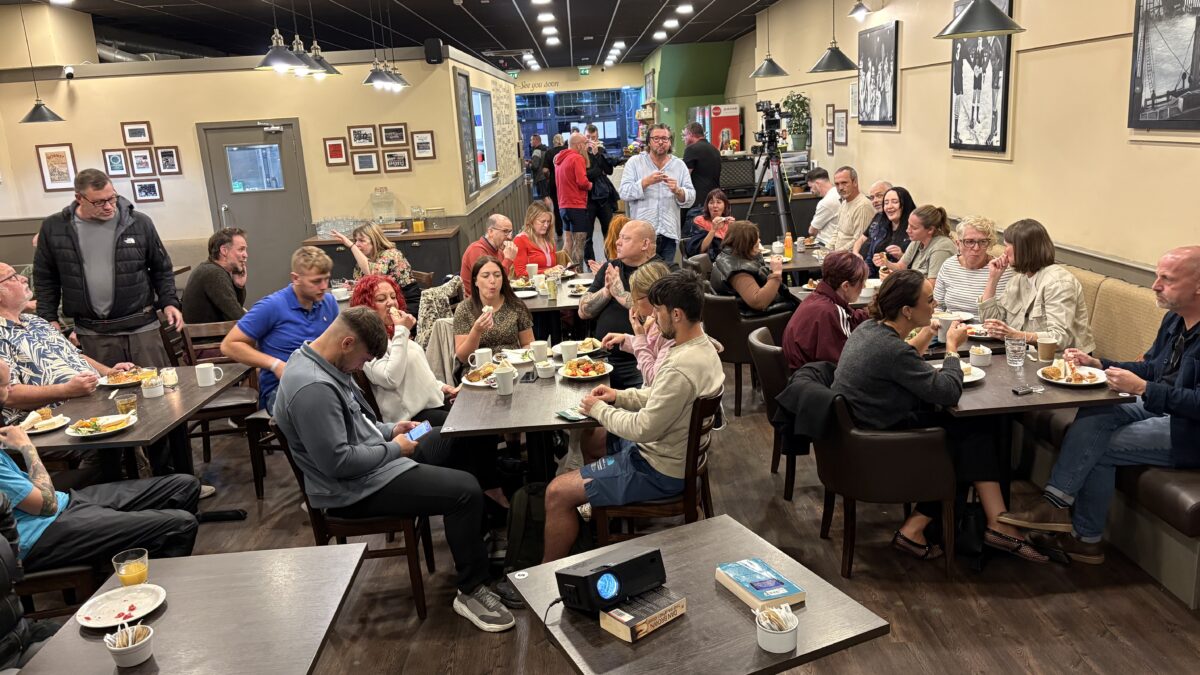
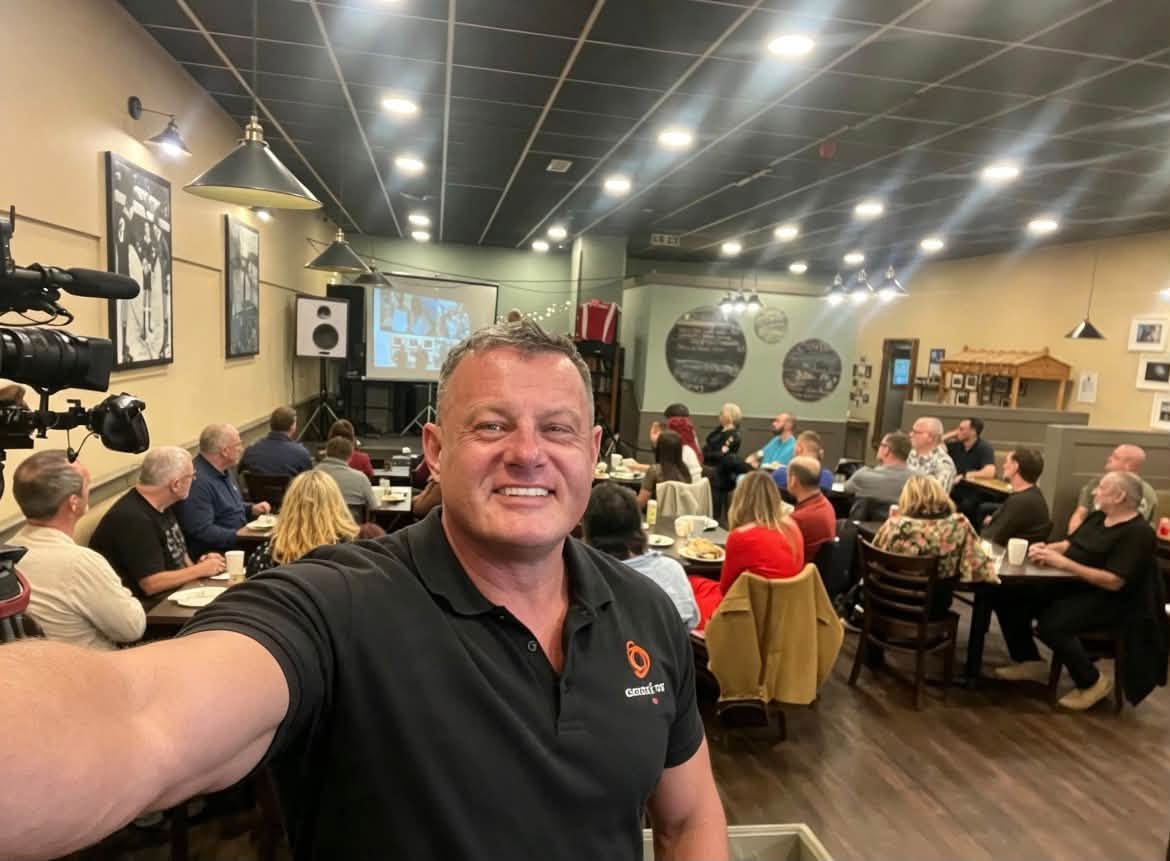
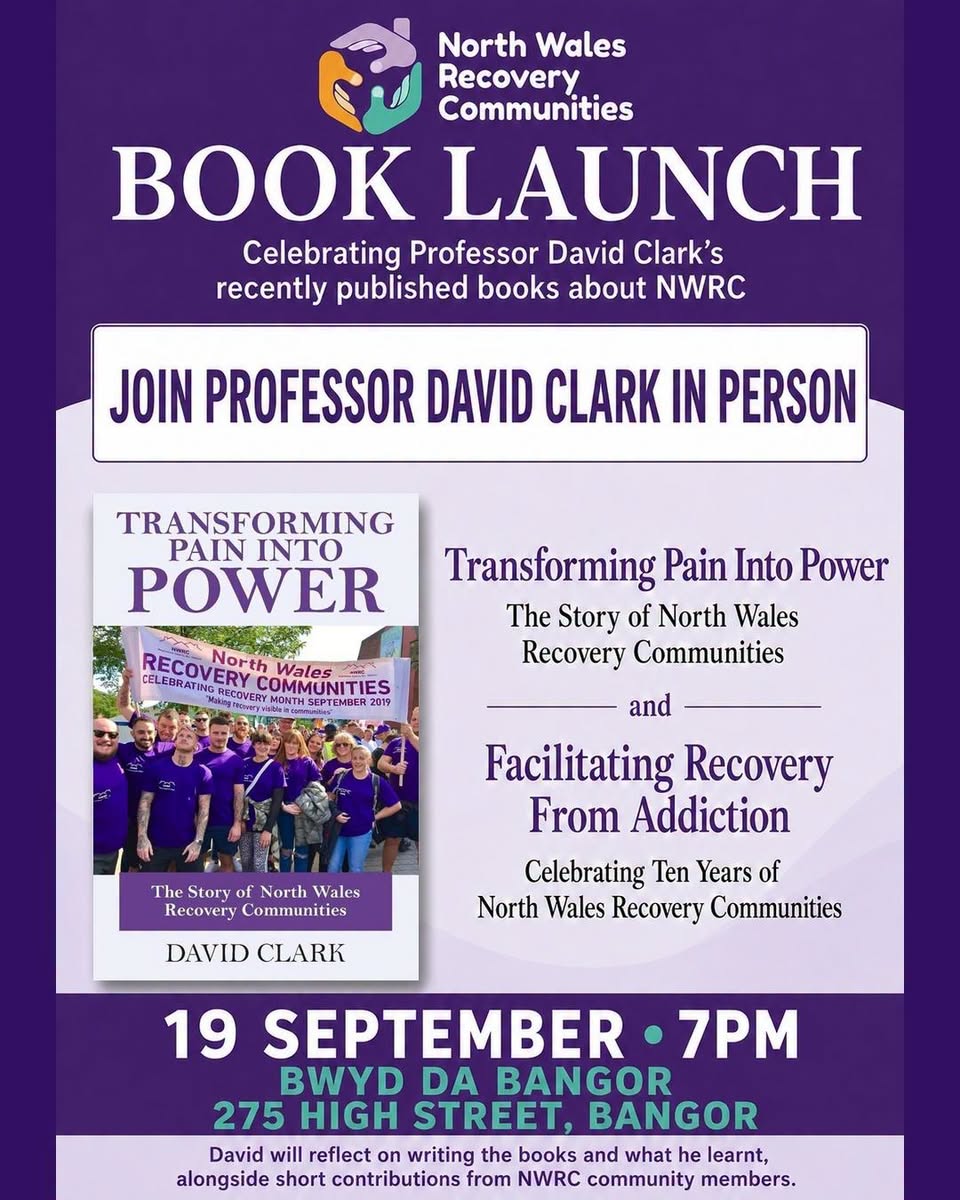 In the afternoon, I headed to Bwyd Da Bangor to check that all was in place for the evening’s Celebration which would take place from 19.00-22.00. I am very grateful to Jo, a member of the Bwyd Da team, who helped me iron out some technical problems. Marcus came to set up his camera and Bwyd Da staff prepared and laid out some gorgeous food for when just over 40 people arrived.
My main talk included describing some of the elements that facilitate recovery at NWRC, using quotes from people who had attended Penrhyn House. Such elements include hope, safety, belonging, connection, relationships, reciprocity, choice, opportunity, and story.
I related how NWRC had impacted positively on the wider community by, for example, feeding local people during Covid, setting up Bwyd Da Bangor (and social activities within), and developing Growing for Change (producing high-quality organic food). I illustrated the ripple effect of recovery by showing how initiatives such as Sober Snowdonia, developed by former members of NWRC, were impacting positively in the community.
I then went on to describe the importance of regulation of our brain’s stress response systems through patterned, repetitive rhythmic activity and how this plays a key role in the recovery process through activities engaged in by NWRC members. I emphasised the importance of Bruce Perry’s Neurosequential Model: Regulate->Relate->Reason, and the importance of community for healing.
‘But the key to change, honestly, is that you have a healing environment that’s filled with people who see you. Who make you feel that you belong. Because what they then allow you to do, is that when you are in need of a regulatory interaction where somebody just is present, you can do that. When you’re in need of somebody who is going to do something where you are needing some guidance, intellectual guidance, you have somebody who can do that.’ Bruce D. Perry
I also described the importance of post-traumatic wisdom:
‘When you have lived through adversity, you come to a point in where you can look back on your life, reflect, learn, and grow from the experience. I believe it is hard to understand humankind unless you know a little bit about adversity. Adversity, challenges, disappointments, loss, trauma – all can contribute to the capacity to be broadly empathic, to become wise. Trauma and adversity, in a way, are gifts. What we do with these gifts will differ from person to person.’ Bruce D. Perry
My final two slides focused on a review of my big book written by Carlie Atkinson, CEO of the amazing Aboriginal healing initiative We Al-Li Programs.
My first talk was followed by excellent ‘Transforming Pain Into Power’ Shares by NWRC Members Marc Yates, Saffron Roberts, Alex Magson, Lee Daly, and Sophie McCluskey. I was really pleased with the quality of these inspiring Shares, and they were very well received by members of our audience. Sarah Flynn, former Chair of NWRC Charity Trustees, described her top ten amazing NWRC experiences.
In my second shorter talk, I emphasised how disconnection was causing a major problem in society today, leading to increases in mental health challenges and addiction. I emphasised the need to empower whole neighbourhoods and communities to heal, thereby facilitating recovery from addiction and mental problems, as well as from adversities such as trauma, poverty, and disconnection. I described how Asset-Based Community Development (ABCD) was an important approach for empowering neighbourhoods and communities to heal.
These ideas were expanded upon in Rich Price’s excellent talk in which he first described the Ripple Effect of Pain (through the individual, family, community, and wider society) and then the Ripple Effect of Recovery. He then asked how do we transform recovery power into community? His answer: ‘By moving beyond the recovery bubble and placing lived experience, relationships and contribution at the heart of everyday community life through the activation of community connectors.’
Rich then introduced the concept of ‘Community-Centred Relational Recovery in Practice’, an idea you will hear more about in the future.
Prior to a final thank you from James Deakin and myself, Ed Day gave a brilliant ‘spontaneous’ talk which I found to be really inspiring. I was so pleased that Ed, who is a leading voice in the recovery field, a psychiatrist, and the Government’s National Recovery Champion, attended the Celebration. He was able to see what amazing work was being done at NWRC, and meet James Deakin and his colleagues and friends. I am so pleased that Ed, as well as Lee Hogan, the developer of Moving On In My Recovery, attended the event.
After the talks, NWRC sold some of my longer book, ‘Transforming Pain Into Power: The Story of North Wales Recovery Communities’, which I signed for the book purchasers.
It was a very enjoyable evening.
My apologies for the delay in posting this blog post, but I’ve been busy with family in Manchester, and I have been in Derry-Londonderry since Thursday, when I have been conducting various interviews and attending the Recovery Walk Northern Ireland. More about my latter visit in a later blog post.
Screenshot