

It’s hard to believe that someone who was in the early stages of recovery from a very long addiction to heroin and crack cocaine would meet a group of senior police officers… and this would lead a decade later to that person receiving an MBE in the New Years Honours. But that’s what happened to Marcus Fair, the Founder of Eternal Media, which is based in Wrexham, North Wales. This blog post focuses on the meeting that ‘catapulted’ Marcus forward into an outstanding career and into the hearts of many people who had struggled with adversity in their lives.
In my last post, I related the Story of Simon Shaw, former North Wales Police Assistant Chief Constable, who has been a strong addiction recovery advocate. It is very important for the Recovery Movement to have such champions who hold highly responsible positions in society and are not in recovery themselves. Simon is a great believer in the power of storytelling, arguing that people can gain a greater emotional buy-in to a personal story to which they can relate, compared to seeing a professional report full of charts and graphs.
Around 2014/15, Simon spent a good deal of time talking with Tony Ormond, a person in recovery and a service user representative for the local Area Planning Board. He realised that people in recovery were a great resource that society should be tapping into and using, particularly as many of these people want to help others get out of the chaos of addiction and crime. He started to develop initiatives which aimed to signpost people from prison cells to treatment services. He also wanted to get people in recovery to come and meet people in their prison cells, and tell them that their life can be very much better. I continue the Story in this blog post, using the voice of Simon Shaw as well as that of Marcus Fair.
A Meeting (Simon’s Perspective)
My latter aim described above proved a step too far for the time, as there were a lot of barriers to overcome. Many people in recovery who would be involved as a resource had very long conviction sheets, and most senior managers in the police force who reported to me were resistant to my idea of giving ‘the keys to the police station’ to ‘convicted criminals’.
However, I still wanted to take a gamble and push boundaries. I invited three people in recovery, of whom one was Marcus, to tell their Stories to a room full of senior police officers from around North Wales. I wanted the officers to buy into my vision, see recovering people as a resource and not think in terms of ‘them and us’.
When everyone assembled in the conference room, the atmosphere was very frosty. The officers were only there because I wanted them there, and they wanted to please me. However, they clearly thought I had gone mad. They sat there sternly with their arms folded, and I felt very awkward.
The session began and I continually looked around the table at the officers. Their demeanour softened as the stories were told. At the end of the session, the officers were approaching the three in recovery requesting their contact details and asking them to get involved in various things. The officers now realised that we are all on the same side, despite our greatly varying backgrounds. We all wanted the same thing. I again saw the power of storytelling in helping engage people at a human level.
I wondered how we could continue on from what I had seen in that room. I wanted every police officer in North Wales to hear such stories, but I couldn’t get them all into a room! Marcus suggested that he make a film of people telling their stories. I thought he meant that we would sit around a table and he would film three people telling their story.
I didn’t know that Marcus had bigger ambitions for the film. I also didn’t know that he hadn’t been in recovery for long. In fact, I knew nothing about his background. I just knew he didn’t want any money for doing the work. Thinking that I had nothing to lose in helping Marcus make a film, I agreed.
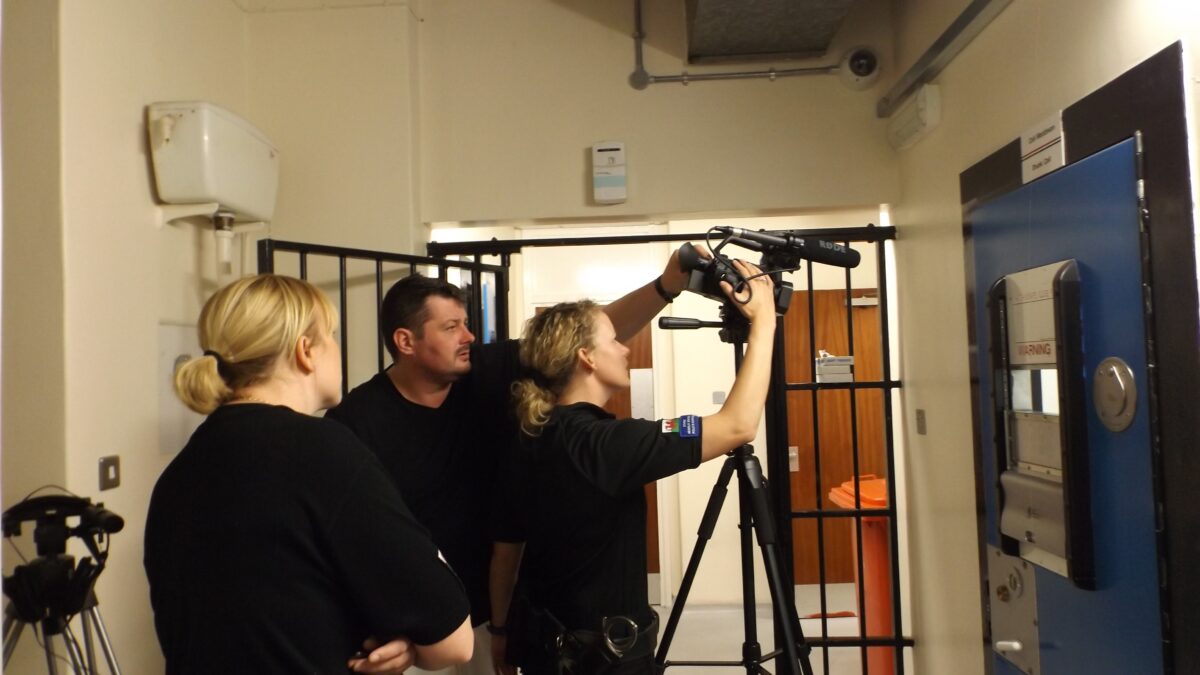
Marcus asked if I could second some police officers to work with him on the film. I gave him three police officers to work on the film part-time. He then wanted a police car, some police uniforms and then the keys to the cell block. It reached a point where I was telling myself I’ve committed myself to this, and if it doesn’t work out I’m retiring next year after anyway. Mind you, it wouldn’t be the sort of way I had wanted to end my career.
A Meeting (Marcus’s Perspective)
Tony Ormond and Simon Shaw arranged for Ade the Blade and I, and one other in recovery, to give a talk about our lives to senior officers of North Wales Police. Simon was not only the Assistant Chief Constable of North Wales, but also a champion of the recovery cause, believing that people could change with the right help. He is a humanitarian, but he also knew that a lot of police money and time could be saved if high level offenders could be helped to find long-term recovery.
The low morale of members of the police force, who were repeatedly banging up people like me, could be improved if such high level offenders were given the right help at the right time by the right people so that they could find long-term recovery. In Simon’s mind, our talks would show to his colleagues that recovery was possible, even for the worst of offenders.
As we told our stories, the initial prickly mood in the room changed in a positive way, and officers started to ask questions. After the talks, Simon asked me if I would do the life story session again to other police officers. I replied, ‘Why don’t you just make a film?’
Simon said he wasn’t confident about the police film team, likening their work to a 1980s VHS ransom demand video from the IRA. He asked if I could do a better job. I said I could. He then asked me what I needed, not knowing that I was straight out of a rehab and had no filmmaking gear at all. I requested three police officers with whom I would work. I’d make a police training film working with these officers (Gemma, Rosie and Gina) who had no filmmaking experience whatsoever. Simon agreed.
That was part of the beauty of Flipped It! Absolutely nobody knew what they were doing, whether it be on the police side or on the people in recovery side of things. It totally levelled the playing field that everybody, bar me, was clueless about film production.