

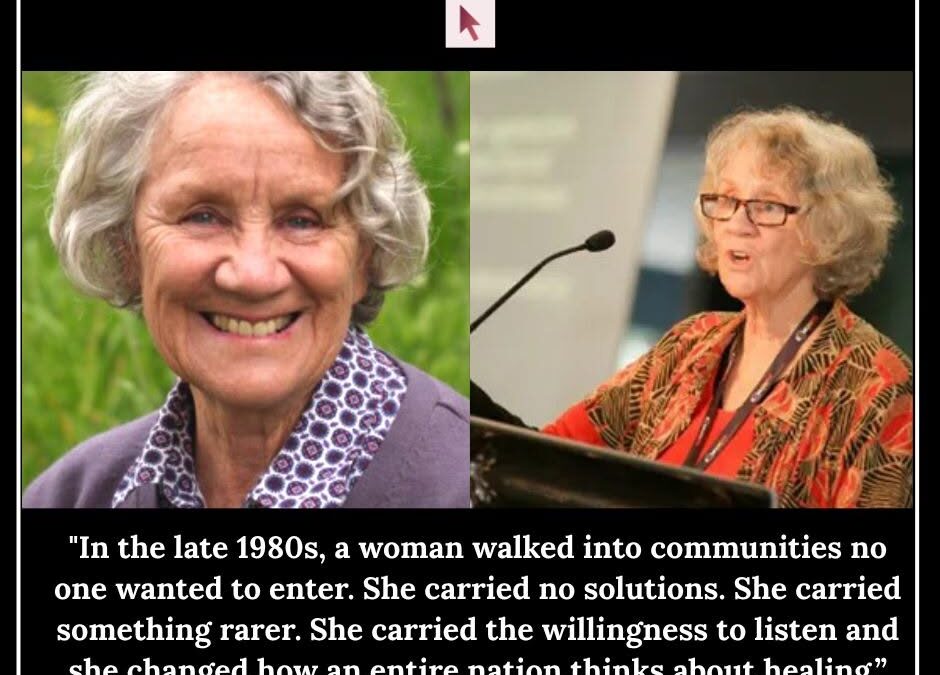
‘Her name is Professor Judy Atkinson. And most people have never heard of her.
Judy is a Jiman woman from Central West Queensland and a Bundjalung woman from Northern New South Wales.
She also has Anglo-Celtic and German heritage. She grew up understanding, in her bones, what it meant to carry more than one story at once. To belong to more than one wound.
She had been working in Aboriginal community health and welfare for years when, in the late 1980s, something happened that she later described as a moment of rage.
A team of outside experts had been brought in to assess a crisis in Aboriginal communities. Children were being sexually abused. And the experts – the credentialed, well-paid outsiders – began floating a theory. Perhaps, they suggested, this violence was cultural.
Perhaps it was simply the way things were done.
Here’s what makes it worse, officials listened to them.
Community leaders had been raising the alarm for years. Aboriginal women and Elders had been naming the crisis, demanding action, asking to be heard. And instead of listening to the people living it, the system imported experts who didn’t. In yet another act of violence, their concerns were overridden.
Judy Atkinson refused to accept it.
She didn’t issue a press release. She didn’t hold a protest. She went into communities in Central Queensland and she sat down. She listened. For 5 years – from 1993 to 1998 – she gathered the lived stories of families and communities who had endured not just one generation of trauma, but layers of it. Dispossession. Violence. Removal. Grief passed down like a terrible inheritance.
What she found was not cultural practice. What she found was trauma – deep, transgenerational, colonial trauma – being lived out in bodies and families who had never been given the language or the space to begin healing.
She named it. She documented it. And she proposed a way through.
In 2002, she published Trauma Trails – Recreating Songlines, The Transgenerational Effects of Trauma in Indigenous Australia. It was based on her doctoral research at Queensland University of Technology. It was shortlisted for an Australian Human Rights Award. And it did something rare for an academic book – it moved people. Not just scholars.
Practitioners. Community workers. Parents. People who read it and said: they are talking about us. They are talking about me.
The book introduced many readers to a concept Judy had woven through all her work, Dadirri. A deep listening practice drawn from Aboriginal knowledge. The idea that healing begins not with an answer, but with a witness. Not with a solution, but with someone who truly, patiently, humbly hears.
She told communities, the storyteller is the teacher. The listener is the student.
She had co-authored the Aboriginal and Torres Strait Islander Women’s Task Force on Violence Report for the Queensland government in 1999 – a landmark document that named what was being denied, demanded what was being withheld, and gave community voices the weight of official record. It took years. It met resistance. But it existed now, on paper, in the record, undeniable.
She founded We Al-li – a healing program whose very name carries meaning. In the Woppaburra language, We means fire. The fire that cleanses the earth to make way for new growth.
She became Head of Gnibi College at Southern Cross University, training a new generation of Aboriginal and Torres Strait Islander trauma workers. She helped develop the Graduate Certificate in Indigenous Trauma Care and Recovery Practice at the University of Wollongong – a qualification designed specifically to build a skilled healing workforce inside communities. Not outside looking in. Inside.
In 2006, she received the Carrick Neville Bonner Award for her curriculum development and teaching practice.
In 2011, Harvard University awarded her the Fritz Redlich Memorial Award for Human Rights and Mental Health through its Program for Refugee Trauma. A woman who had once watched outside experts dismiss Aboriginal women’s testimony was now being recognised by one of the world’s foremost institutions.
She retired from formal academic life at the end of 2010. But she didn’t stop. She kept working – in communities across Australia, in Papua New Guinea, in Timor Leste. She called it educaring, education as healing. The idea that you cannot separate learning from love. That the first act of teaching someone is to make them feel safe enough to hear you.
On 26 January 2019, she was made a Member of the Order of Australia – recognised for her services to the Indigenous community, to education, and to mental health.
More than 30 years after she first walked into those communities and chose listening over expertise, her work has shaped how hospitals, schools, courts, and welfare systems across Australia approach trauma.
She never claimed to have the answers. She claimed only to have the willingness to hear the question.
Share this with someone who needs to know – that sometimes the most powerful thing you can offer another human being is not advice, not a solution, not credentials. It is the simple, radical act of sitting down and truly listening.
What would change in your world – at work, at home, in your community – if more people practised real, deep listening before they acted?”
Let this story reach more hearts…..
Judy’s daughter Carlie, CEO of We Al-li, added these words to her repost of the original:
‘All of our mobs across this place we now call Australia have a language word for Deep Listening. The language word used in this post is Dadirri is from the Ngan’gikurunggkurr people from the Daly River region, Northern Territory brought to us by Aunty Miriam Rose Ungunmerr-Baumann.’