

In the third part of Marcus Fair’s Story, I described how Tony Ormond and Ade ‘The Blade’ would put a case study forward to the Area Planning Board (APB) for Marcus to be given a rehab place, but they couldn’t use his name as he was classed as a ‘no-hoper’. Instead, they created the pseudonym ‘Little Brother’ for him.
…..
Tony eventually approached the Chair of the APB delivery group, Simon Shaw, and poured his heart out about this man living on the streets of North Wales, showing Simon various emails and notes he had made. This was not something that one would normally do in Tony’s position. Simon, who was also Assistant Chief Constable for North Wales, responded positively to Tony’s plea. I was funded for a clinical detox and then three months at Open Minds rehab in Wrexham, starting in 2014.
I did really well during this period; it was a no-brainer that I should be funded for another three months at Open Minds. Despite the rehab costs, there would be a huge saving, given how much I cost the community, both financially and in causing problems for other people.
Over the many years of my addiction, I had an army of counsellors, police, lawyers, family, friends telling me how to get ‘clean’. However, it was only after going to Open Minds rehab, which was staffed by people in long-term recovery, that I learnt how to get clean and stay clean. I went into Open Minds thinking I was the worst person on the planet. I was riddled with the guilt and shame I had been carrying for many years.
One counsellor in particular helped me deal with this guilt and shame in my early days at Open Minds. Pete had previously had the same experiences as me when he had been addicted to heroin and crack cocaine, just different locations and casts. This meant that, unlike what occurred with previous well-meaning professionals who lacked lived experience but did their best to help me, there were whole conversations that Pete and I didn’t need to have. He knew where I had been, as he had been to the same places and the same depths of despair.
Early in my stay, Pete asked me whether I felt that what I had done in addiction was my fault. ‘Yes, of course’, I replied.
‘Why do you think it’s your fault? Would you do it now?’ Pete asked.
‘Well no, of course I wouldn’t do it now,’ I replied.
‘So it wasn’t you doing that then, was it? It was you as an addict doing that.’
Pete smiled as he continued: ’I’ll tell you why else it isn’t you fault doing what you did. Because if it’s your fault you did that, then it’s my fault I did what I did… and it’s not my fucking fault doing what I did.’
No-one had spoken to me in this way before. It was a real moment for me. Those words, and Pete breaking out into laughter at the end, were so powerful. The shame and guilt I had felt for so many years just lifted. What happened helped clear the wreckage of my past and to allowed me to move forward. I also realised that self-pity, which I had experienced for so many years, was of no value; it was just wasted energy.
There were about seven or eight counsellors at Open Minds, all of whom were in recovery, who I saw during group sessions and at other times. Their personalities and the lives they led, which we heard about, were different to each other. Us residents were surrounded by people in recovery who had what we wanted and from whom we could learn so many different things. One could cherry pick what one wanted to know and use, and without even knowing it we put different combinations of knowledge together and implemented them in our daily lives. These combinations would change over time if things didn’t work out. Importantly, all of this was happening in an environment which really felt like a safe space.
Jill Whittingham conducted very powerful workshops that got you thinking about yourself and your interactions with other people. Jonathan, another counsellor, was always so logical about stuff and full of fun. I would just talk about ‘this and that’, and have a good laugh, with the night manager Nicki and his colleagues on that shift.
I still visit Open Minds two or three times a week to chat with clients and talk with Nicki and other counsellors, Jonathan and Mike. These three counsellors have become good friends and are still very supportive of me, even after 12 years. Jill is a close friend who has run the therapeutic photography programme, Recovery in Focus, for Eternal Media for a number of years.
Whilst at Open Minds, I generally tried to fly under the radar and avoid conversations about ‘me’. Another advantage that Pete possessed was that he mostly talked about Pete, rather than me. That was very helpful, because as he talked about him, I opened up a bit about myself. That was obviously Pete’s tactic. I also noticed that I enjoyed talking with Pete whilst walking, as I felt more relaxed. Sitting on a sofa or a chair one-on-one with a counsellor, and knowing there is a fixed time of the session, doesn’t work for me.
There were so many people who you could interact with at Open Minds, which was a great advantage. However, this was no joy ride—it’s not meant to be—and I certainly didn’t ‘enjoy’ rehab. It wasn’t an easy process; there were lots of assignments to work through and write about, and an awful lot of looking inside at oneself. And that’s why it’s so tough leaving rehab, because you’ve been focused on looking inside yourself, and not enough looking outside yourself at the community beyond the building in which one lived. That’s one reason why I like NWRC so much. After an initial period, they get you interacting in the outside world whilst living at Penryhn House.
When I entered Open Minds, I had decided to just keep my head down under the radar, and just use the rehab as a safe place to get clean. However, I ended up interacting with everyone in the rehab and they all impacted on me. However, I didn’t realise that over time I had experienced a change in my cognitive functioning until I stepped outside of the rehab. And when I later reflected on what happened in the rehab, I also realised that I had caught recovery largely through osmosis.
After leaving Open Minds, I went to a so-called Sober House in Wrexham. My dealer from Llandudno just happened to be waiting outside the house when I arrived. He asked me, ‘What you after?’ ‘Nothing, I’m clean,’ was the reply. The dealer laughed. I had unexpectedly just received a couple of grand as dole backpay, but my legs kept walking. It helped that I had a radio project to start working on with Charlie, a really good friend of mine. That was the first time I had ever walked away from a drug dealer empty-handed.
The Sober House was not so sober. In fact, nearly everyone was using… and some were dying. Tony Ormond stepped in and helped me rent a NACRO (National Association for the Care and Resettlement of Offenders) flat. This place was a shit-hole. It was located opposite a chemist where addicts went in the morning to get their methadone, which in turn was next to a phone box, where the same people came out of the chemist and phoned their dealer, which was next to a park where they all congregated to meet their dealer and then take their drugs, which was next to a Salvation Army building where they would go to eat. I would open my curtains in the morning and see all this going on.
Despite all the problems, I was very grateful for my flat. Moreover, AVOW (Association of Voluntary Organisations), and then Champions House in Wrexham, gave me access to a room during the day. It was so important for me to get up and go somewhere else in the morning.
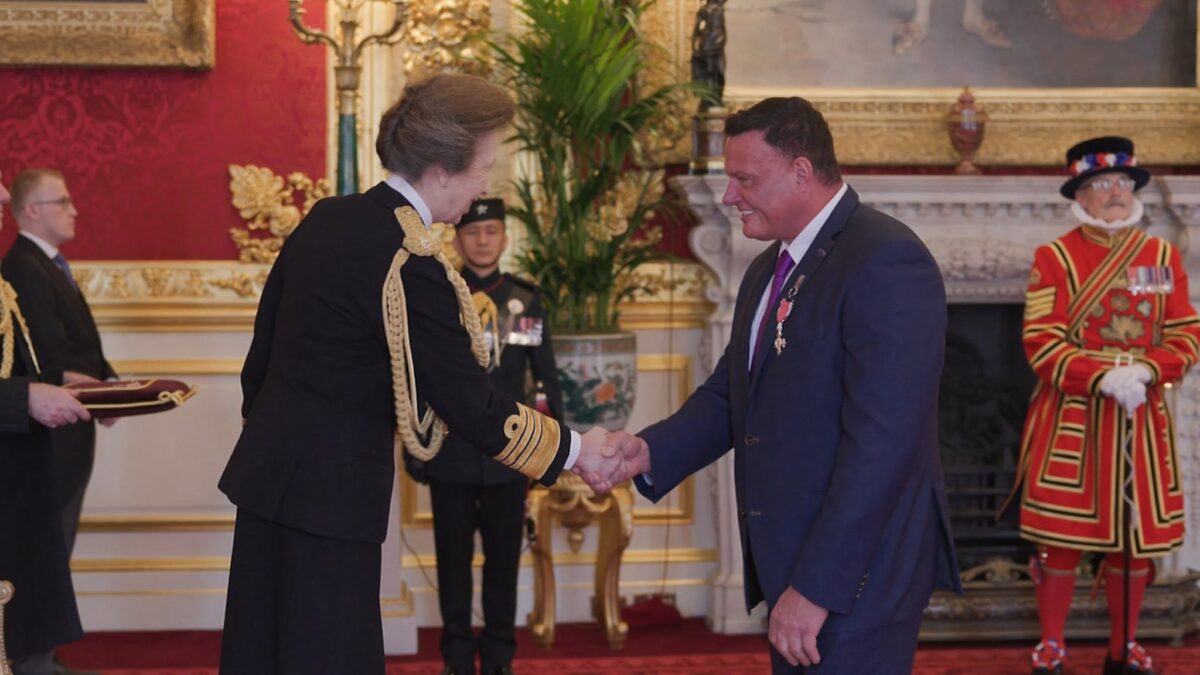
Marcus Fair is Founder of the recovery initiative Eternal Media. On the 3rd of March this year, Marcus received his New Years Honours MBE for Services to Addiction Recovery, to Ex-offenders and Tackling Homelessness. A wonderful day for Marcus… and for Recovery!